




Periods of geopolitical conflict are unsettling, touching people, economies, and markets alike. The headlines are intense, emotions run high, and financial markets often respond with sharp, short-term volatility. At moments like these, it’s natural for investors to ask: What does this mean for my portfolio, and should I be doing something differently?
Markets have weathered wars and conflicts before. And while volatility often follows, it rarely alters the trajectory of markets over the long-term.
What happened?
Tensions in the Middle East escalated sharply in early March following direct military action involving the United States, Israel, and Iran. What began as targeted strikes quickly broadened into retaliatory missile and drone attacks across the region. The situation has remained fluid, with significant uncertainty surrounding the political leadership in Iran and the potential for further escalation.
As is often the case during periods of conflict, global markets reacted swiftly. Equity markets experienced heightened volatility as investors grappled with the implications for economic growth, energy prices, and geopolitical stability.
What has history taught us about how markets react to geopolitical conflicts?
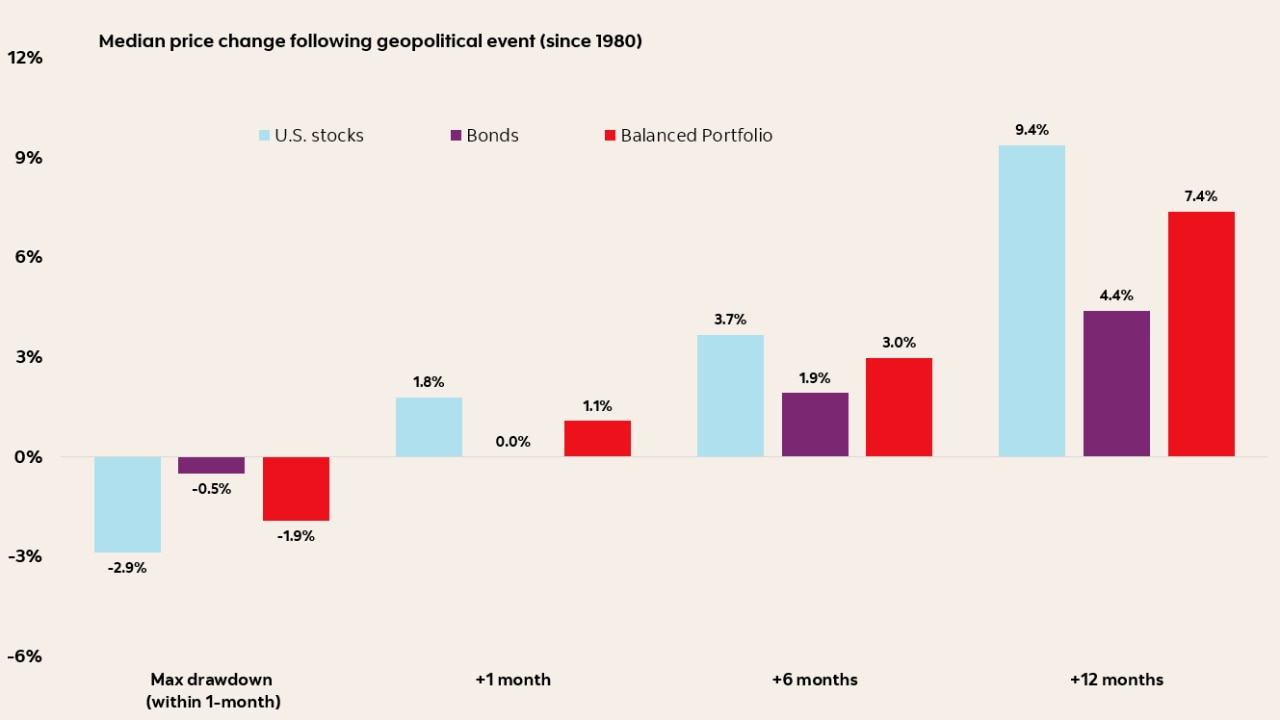
Market volatility during conflicts is not new. From past wars to regional crises and geopolitical shocks, history shows that markets often decline initially, stabilize as information improves, and eventually recover, often well before the conflict itself is resolved.
In fact, many of the strongest long‑term returns have been generated by investors who remained invested through periods of uncertainty rather than attempting to sidestep short‑term drawdowns. (see Figure 1)
Figure 1: Market recoveries following major geopolitical conflicts
When uncertainty rises, discipline matters
Financial markets dislike uncertainty. When the future becomes harder to predict, investors often respond by reducing risk by selling their investments or seeking perceived safe-haven assets.
Trying to time markets during periods of stress can be particularly damaging. Selling after markets have already declined and reinvesting once conditions “feel safer” often results in missing recoveries, which typically occur quickly and unpredictably. This behavior can erode long‑term returns and can put your financial goals in jeopardy.
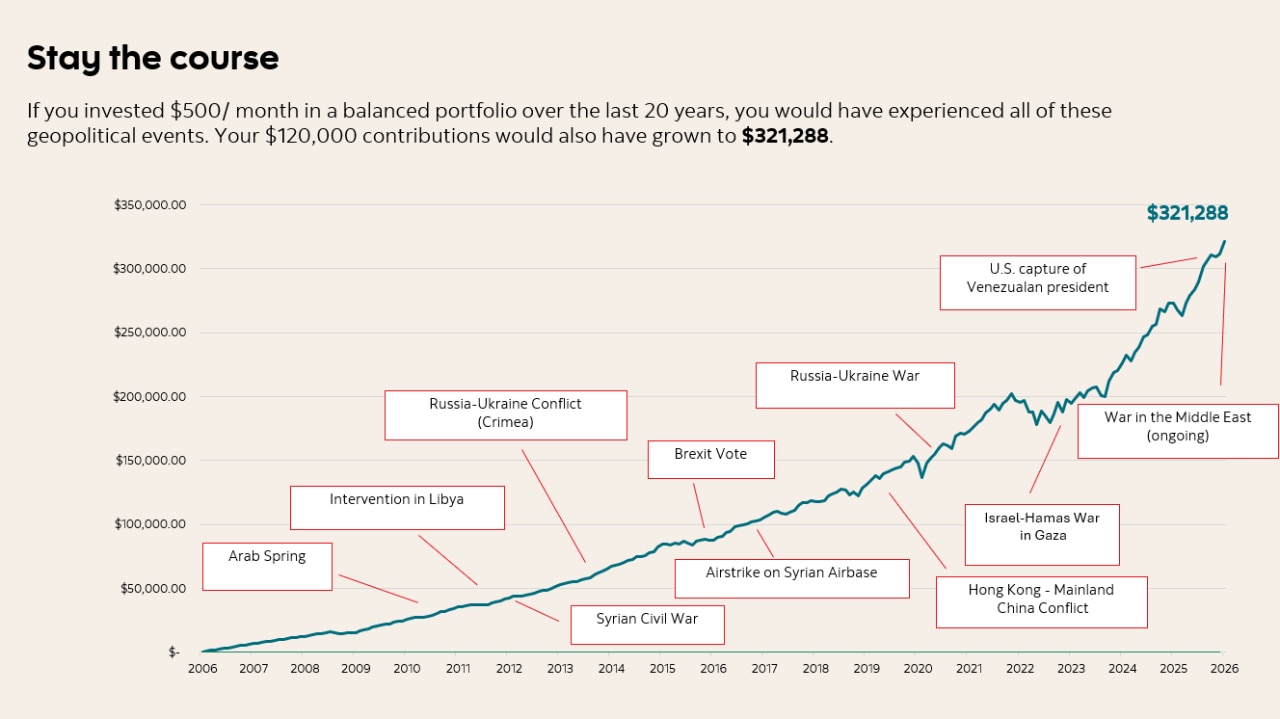
Moments like these serve as an important reminder of why investment discipline matters. A long-term investment plan is built with the understanding that markets will experience cycles, including periods of growth, pullbacks, and occasional shocks. Investing regularly in a diversified portfolio that includes a mix of equities, fixed income, and other investments can help manage volatility while participating in growth over the long-term (see Figure 2).
Figure 2: Consistency counts
Portfolios designed with uncertainty in mind
During volatile periods, investors often feel the urge to “do something” to regain a sense of control. In many cases, however, the wisest decision is typically to stay invested and rely on a diversified portfolio.
Scotia Portfolio Solutions are built to navigate a wide range of market environments, including periods of geopolitical stress. Managed by Scotia Global Asset Management’s Multi‑Asset Management Team, the portfolios are diversified across asset classes and regions to help manage volatility while remaining aligned with long‑term objectives. Active management, oversight, and regular rebalancing keep portfolios responsive as conditions evolve, so clients don’t have to react to short‑term headlines.
Moments like this can feel heavy, and we know the images and stories coming out of the region are deeply troubling. In that context, we design these portfolios to help carry you through periods of real uncertainty. As portfolio managers, our responsibility is to stay focused on our commitment to you and on what we can control – our process. This means staying disciplined, making changes when the data truly shifts, and helping keep you on track toward your long‑term goals.
What to do when markets feel uncertain
Periods of geopolitical tension remind investors of an uncomfortable truth: uncertainty is unavoidable. What is within your control is how you respond to it.
Markets will continue to face shocks—geopolitical, economic, and otherwise. While volatility is uncomfortable, it’s also a normal and expected part of investing. By staying invested, remaining diversified, and sticking to your long-term plan, you’ll be well-positioned to weather short‑term turbulence and stay on track to reaching your goals.
In uncertain times, staying the course is one of the most important decisions an investor can make. A disciplined, diversified, long‑term strategy provides the foundation to manage volatility and remain focused on reaching your long‑term goals.
