




Whether you’re saving for retirement, your dream home or your children’s education, fixed income investments will most likely feature as an integral part of your diversified investment portfolio. While this asset class is commonly known for providing regular income, it offers many other benefits such as providing stability and diversification to portfolios.
What is fixed income?
Fixed income is a broad asset class that includes bonds, treasury bills, and other securities such as mortgage- backed securities and convertible debt. As the name suggests, these investments typically generate a regular stream of interest income and/or a future lump sum payment at maturity.
Bonds are synonymous with fixed income investing. A bond is a debt instrument that is essentially a loan agreement between the issuer (borrower) and an investor (lender). They are typically issued by governments and corporations to raise money to fund new projects or maintain day-to-day operations.
What are the benefits of investing in fixed income?
Income generation: Many fixed income investments can help you generate a steady source of income, the need for which can be more pronounced in your retirement years. Compared to holding your investment in cash alone, the fixed income asset class can invest in bonds with longer maturities or different creditworthiness in order to generate a higher level of income. Overall, the income generation from bonds has steadily declined over the past two decades as interest rates have fallen to historical lows. The cost of income has gradually risen as a result (Figure 1).
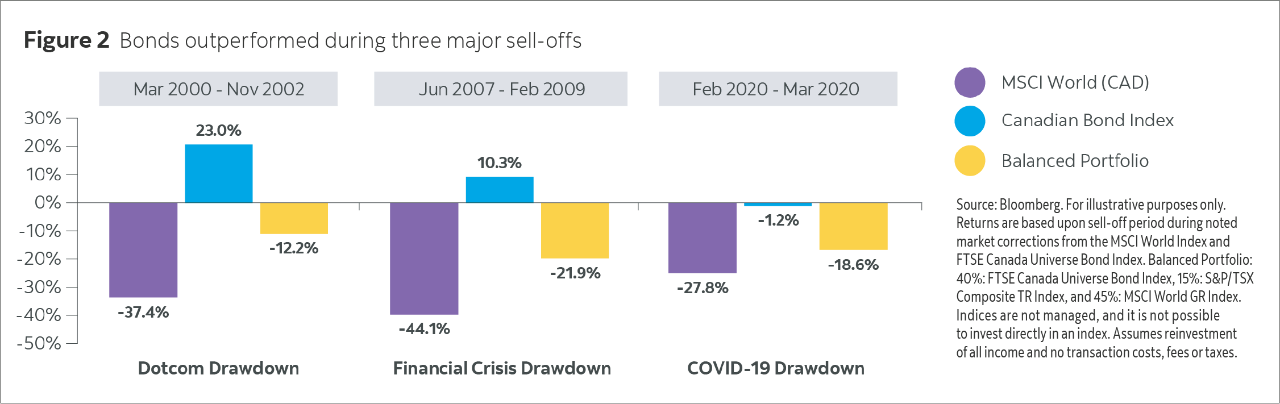
Stability: Fixed income investments have low correlation to equities, meaning they don’t always rise and fall in tandem with stocks. During market downturns, they can serve as shock absorbers that dampen the impact of volatility, while providing you with a source of regular income in the meantime. Figure 2 illustrates how bonds have added stability to a balanced portfolio during three dramatic stock market downturns.
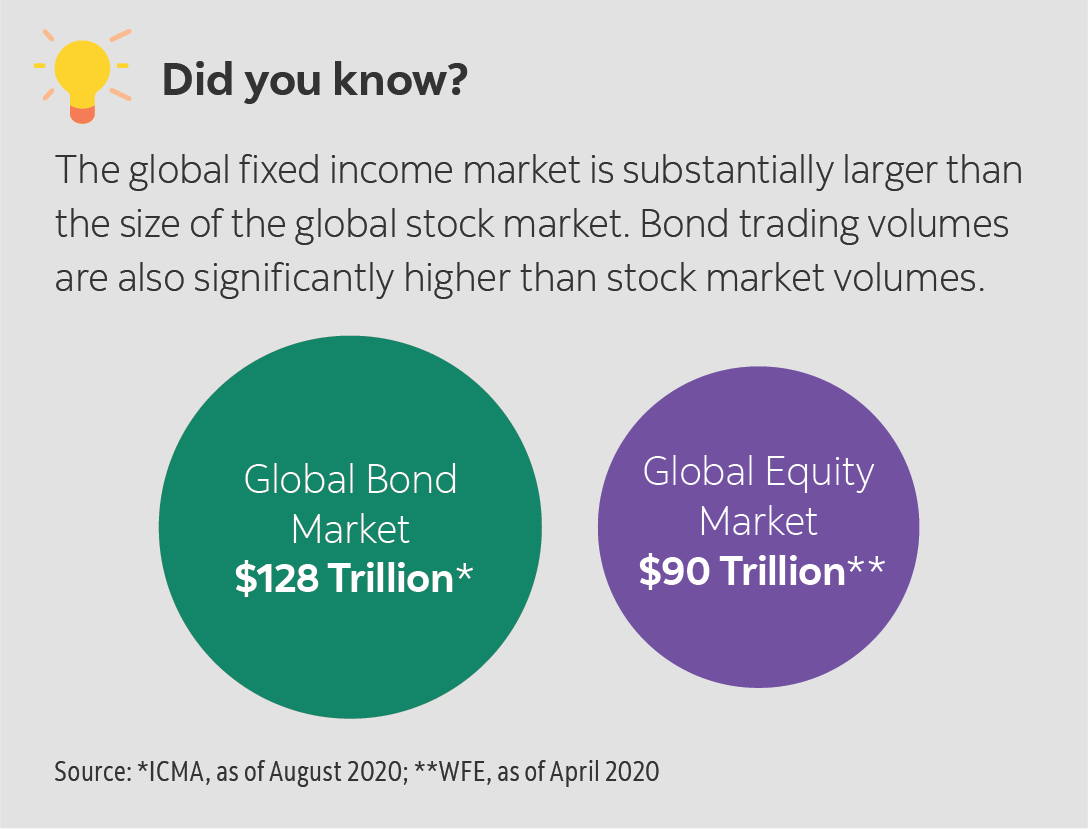
Figure 1:
This slow erosion of yields has resulted in a corresponding rise in the cost of income. In March 1991, investors required just under $92,000 in 10-year government of Canada Bonds to generate $10,000 in annual income. Fast forward to March 2021 and yield- starved investors had to shell out over $645,000 in 10-year bonds to generate the same amount of income.
Investment capital required to generate
$10,000 in annual income
$91,915
$645,140

March 31, 1991
March 31, 2021
Total Return: Like stocks, bonds can generate capital gains or losses. The total return of a bond consists of the interest payments you receive as well as changes in the value of your original investment. Some fixed income assets offer you the potential to generate attractive returns by assuming more risks such as credit risk, interest rate risk, liquidity risks, to name a few. It’s also important to factor in the reinvestment of coupon interest from a bond portfolio and the benefit of compounding.
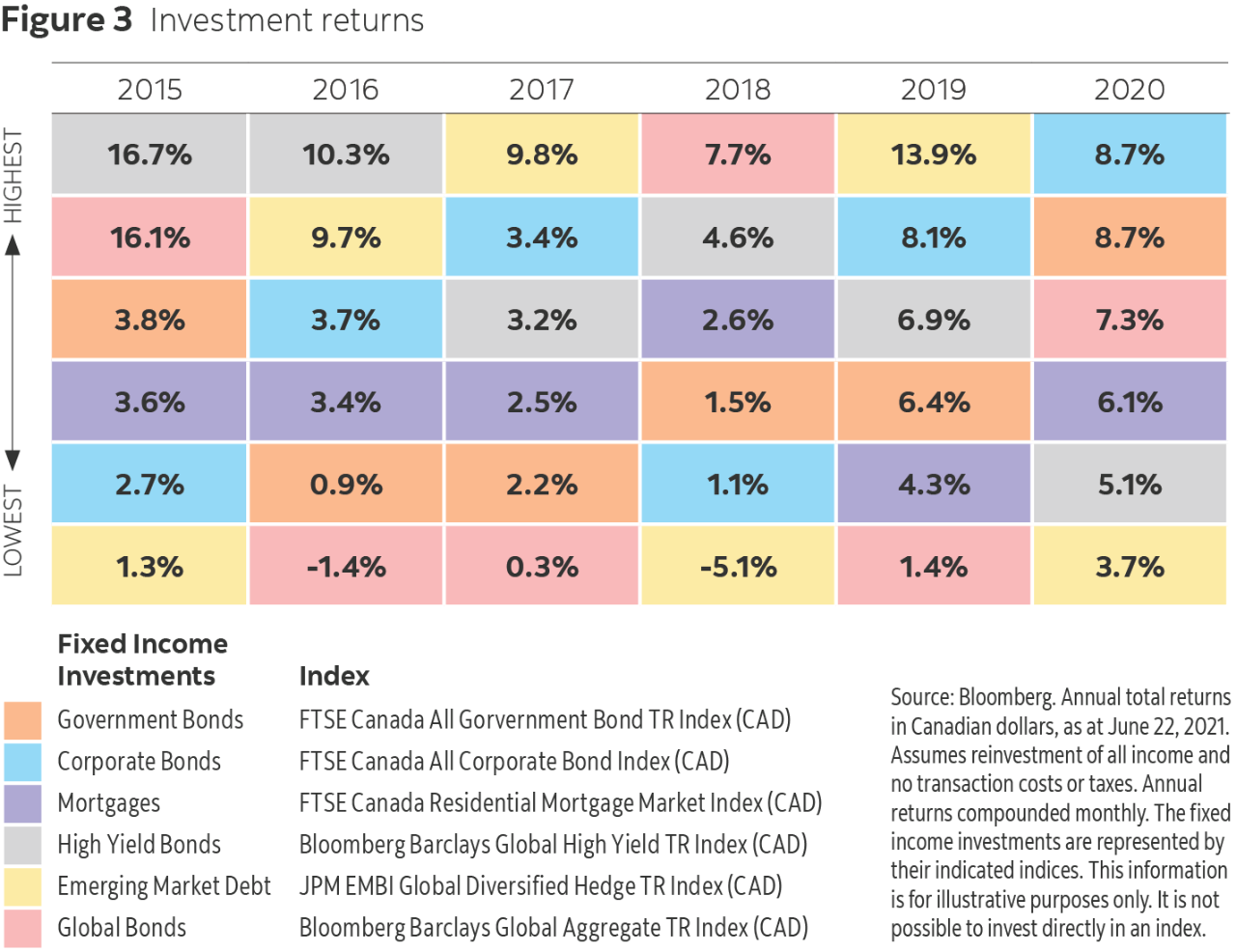
Diversification: Including fixed income in your portfolio can improve diversification, providing an important counterbalance to the volatility of equities. But just like the stock market, no single asset class consistently leads the pack, and the best and worst performers can change from one year to the next (Figure 3). A diversified portfolio that includes a variety of fixed income investments lets you participate in potential gains while dulling the impact of those that have underperformed.
Like the stock market, there are different risk and return profiles for different bond categories. In addition, short- and longer-term performance can vary. It’s important to invest in a well-diversified portfolio that fits with your risk appetite and objectives.
Although fixed income investments can be relatively less risky, they are not risk-free. Some of the risks can be managed by diversifying your investments and investing in actively managed portfolios.
Inflation risk: Bonds provide a fixed amount of income at regular intervals. But if the rate of inflation outpaces this fixed amount of income, you may risk losing purchasing power.
Credit risk: Credit risk, also known as business risk or financial risk, is the possibility that an issuer could default on its debt obligation. If this happens, you may not receive the full value of your principal investment. This potential risk usually applies to corporate bonds.
Liquidity risk: Liquidity risk is the possibility that you will be unable to find a buyer when you want to sell a fixed income asset.
Interest Rates & Bond Prices
One of the key drivers of bond pricing is interest rates. Bond prices and interest rates have an inverse relationship. In other words, when rates rise, bond prices typically fall and vice versa (interest rate risk).
If prevailing interest rates are higher than when the existing bonds were issued, the prices on these existing bonds will generally fall. That’s because new bonds are likely to be issued with higher coupon rates as interest rates increase, making the old or outstanding bonds generally less attractive (unless they can be purchased at a lower price). So, higher interest rates mean lower prices for existing bonds and vice versa.
John buys a $1,000 bond that pays a 5% coupon ($50 in annual interest). One year later, he offers his bond for sale.1

Bonds in a rising interest rate environment
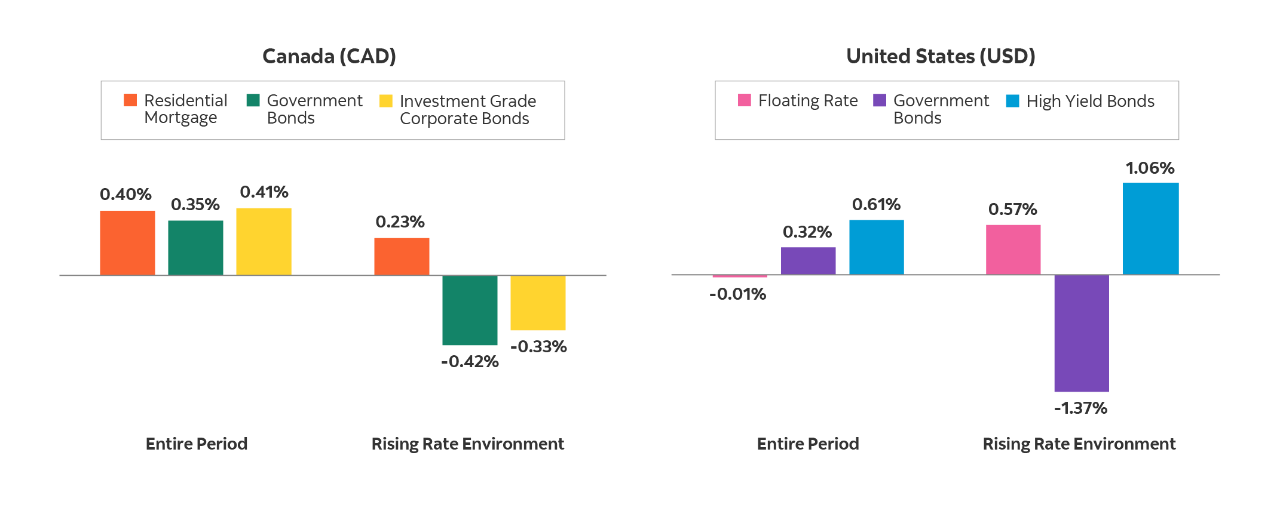
Investors have reaped the benefits of declining interest rates over the past four decades (remember when rates fall, bond prices rise). While the prospects for bonds may not be as favourable as rates rise, their role as a shock absorber during equity market downturns makes them an enduring fixture in a balanced portfolio (Figure 2). Fixed income investments can help limit portfolio volatility and generate income even in rising interest rate environments.A look at the performance of various fixed income asset classes over the past 15 years (Figure 4) reveals that not all fixed income securities are impacted equally by the ebb and flow of interest rates. During periods of rising rates, residential mortgages fared slightly better in Canada, while floating rate and high-yield bonds fared better in the U.S.

Jargon Buster
Credit quality is the likelihood that the bondholders will receive the amounts promised at the due dates.
Higher credit quality means potentially lower risk of issuer default but the trade-off is lower income potential.
Floating rate bond is a type of bond that pays a variable coupon rate.
Active management matters
The enduring quality of fixed income investments to insulate from equity risk has earned them a permanent spot in a diversified portfolio. However, the prospect of increased risk and lower returns from bonds calls for a more active and flexible approach to managing a balanced portfolio’s fixed income allocation. Actively managed fixed income strategies can incorporate a wide array of tools to help insulate portfolios from rising interest rates and to drive incremental returns.
Scotia Portfolio Solutions offer actively managed, multilevel diversification across the fixed income universe to preserve capital, manage interest rate risk, diversify credit risk and generate income. An active approach to the Portfolios’ fixed income exposure employs an expanding toolkit of fixed income strategies to help improve portfolio resiliency and return potential. They are available in a range of strategic asset mixes – from sizeable fixed income allocations for a more conservative investor to smaller allocations for growth-focused investors. A Scotiabank advisor can recommend a portfolio that’s best suited to meet your unique needs.
® Registered trademarks of The Bank of Nova Scotia, used under licence. © Copyright 2026 1832 Asset Management L.P. All rights reserved. As used in this document, the term “Scotiabank advisor” refers to a Scotia Securities Inc. mutual fund representative or, in Quebec, a Group Savings Plan Dealer Representative. When you purchase mutual funds or other investments or services through or from Scotia Securities Inc., you are dealing with employees of Scotia Securities Inc. Scotiabank may also employ these individuals in the sale of other financial products and services. Activities conducted solely on behalf of Scotiabank are not the business or responsibility of Scotia Securities Inc. Scotiabank® includes The Bank of Nova Scotia and its subsidiaries and affiliates, including 1832 Asset Management L.P. and Scotia Securities Inc.
This document has been prepared by 1832 Asset Management L.P. and is provided for information purposes only. Views expressed regarding a particular investment, economy, industry or market sector should not be considered an indication of trading intent of any of the mutual funds managed by 1832 Asset Management L.P. These views are not to be relied upon as investment advice nor should they be considered a recommendation to buy or sell. These views are subject to change at any time based upon markets and other conditions, and we disclaim any responsibility to update such views. Information contained in this document, including information relating to interest rates, market conditions, tax rules, and other investment factors are subject to change without notice and 1832 Asset Management L.P. is not responsible to update this information. To the extent this document contains information or data obtained from third party sources, it is believed to be accurate and reliable as of the date of publication, but 1832 Asset Management L.P. does not guarantee its accuracy or reliability. Nothing in this document is or should be relied upon as a promise or representation as to the future. Investors should consult their own professional advisor for specific investment advice tailored to their needs when planning to implement an investment strategy to ensure that individual circumstances are considered properly, and action is taken based on the latest available information.
Commissions, trailing commissions, management fees and expenses may be associated with mutual fund investments. Please read the prospectus before investing. Mutual funds are not guaranteed or insured by the Canada Deposit Insurance Corporation or any other government deposit insurer, their values change frequently, and past performance may not be repeated.
