


“Market volatility can feel unsettling, but a sharp drop in prices doesn’t, on its own, tell us that the economy or the companies we invest in have changed. We continue to see resilient economic and corporate fundamentals beneath the headlines, and we remain tactically overweight equities across our portfolios while using diversification to help manage the risks.”
- Wes Blight, Vice President & Portfolio Manager
S&P 500
-4.4%
Nasdaq Composite
-5.5%
U.S. equity markets sold off sharply on November 5, led by AI-related technology stocks, as concerns grew that tighter regulation following the U.S. midterm elections could slow the buildout of AI data centres. The S&P 500 fell 4.4% and the Nasdaq Composite fell 5.5%, their steepest one-day declines since April 2025. Here is how we are thinking about it, and what it means for our portfolios.

Volatility has been sharp, but the economic backdrop hasn’t deteriorated to the same degree
Recent weakness has been concentrated around technology and AI, where investors are reassessing the pace and prospective returns from very large capital-expenditure programs. Importantly, this looks more like a valuation and positioning reset than evidence of a broad economic contraction. Broad earnings estimates remain healthy, while valuations are less stretched than they were at the start of the year. U.S. GDP growth is strong and well supported by resilient consumer spending and elevated increases in business investment. That distinction is important and supports our decision to remain tactically overweight equities across portfolios.

A correction in market leadership is not necessarily a correction in the investment thesis
Much of the concern has centred on AI and mega-cap technology, but the weakness beneath the headlines has been less uniform. While the Nasdaq 100 fell almost 7% in October, the equal-weighted S&P 500 actually rose about 5%. This is technology weakness as a rotation rather than contagion, and with fundamentals remaining strong, it supports our overweight equity position. For diversified investors, broader market leadership is unequivocally healthier than a market dependent on a handful of technology companies.

Selling does not reflect a sudden change in fundamentals
The November 5 selloff was unusually broad, but the underlying backdrop has not materially changed. Outsized drawdowns can be uncomfortable, but they can also create opportunities for disciplined long-term investors. We are monitoring risks closely, but do not believe the recent price action alone warrants abandoning our portfolio positioning.

Diversification can help manage risk during equity market selloffs
Market volatility is not synonymous with equivalent portfolio volatility. Government bonds rallied as equity markets sold off, helping cushion our diversified portfolios. At the same time, recent market leadership has broadened away from the hardest-hit technology names. Our portfolios are deliberately diversified across asset classes, regions and investment styles, helping us to maintain an equity overweight without relying on a single theme or narrow group of stocks.
Volatility often makes market timing particularly costly
The value of staying invested
$10,000 invested in Canadian stocks over 10 years
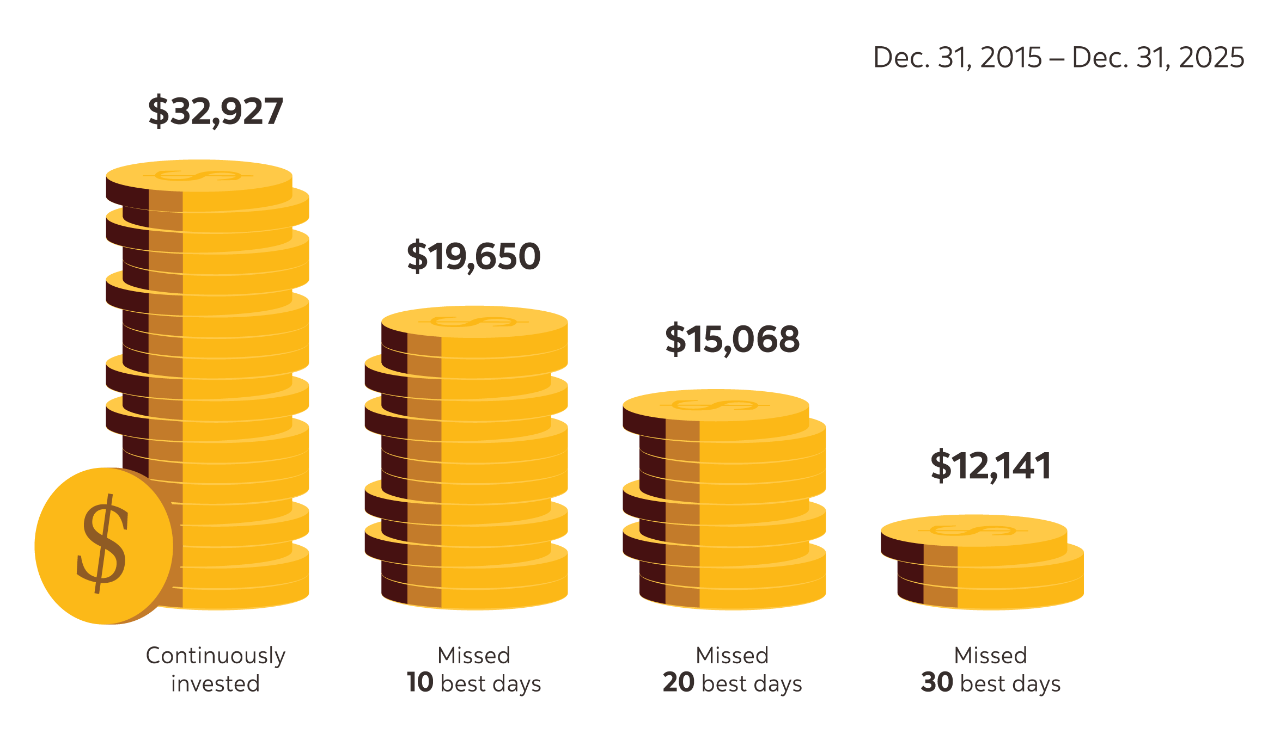
Periods like this naturally create the temptation to wait for greater clarity. But clarity usually arrives after markets have already repriced. As the illustration shows, missing the best 20 market days over the past 10 years would have cut the value of a $10,000 investment in Canadian stocks by more than half, with many of the strongest days occurring during volatile periods.
Our approach is to stay disciplined rather than react to short-term uncertainty. We remain tactically overweight equities across our portfolios because we continue to see the medium-term balance of growth, earnings and opportunity as constructive, while recognizing that volatility may remain elevated in the near term. The objective is to retain participation in further equity gains while providing protection against a more significant correction.
Here’s what you can do
While uncertainty may trigger more volatility and unsettling headlines, we must focus on what we can control. History shows that markets have weathered challenges before, and long-term investors who stay disciplined typically achieve better outcomes. We encourage you to remain invested, stick to your long-term plan, and consult your advisor to ensure your strategy stays on track during these uncertain times.

Craig Maddock, Vice President, Senior Portfolio Manager and Head of the Multi-Asset Management Team

Wesley Blight, Vice President & Portfolio Manager, Multi-Asset Management
© Copyright 2026 The Bank of Nova Scotia. All rights reserved.
® Registered trademark of The Bank of Nova Scotia, used under licence.
Scotia Global Asset Management is a business name used by 1832 Asset Management L.P., a limited partnership, the general partner of which is wholly owned by Scotiabank. ScotiaFunds® are managed by Scotia Global Asset Management. ScotiaFunds are available through Scotia Securities Inc. and from other dealers and advisors, including ScotiaMcLeod® and Scotia iTRADE®, which are divisions of Scotia Capital Inc. Scotia Securities Inc. and Scotia Capital Inc. are wholly owned by The Bank of Nova Scotia. Scotia Capital Inc. is a member of the Canadian Investor Protection Fund and the Canadian Investment Regulatory Organization. Views expressed regarding a particular company, security, industry or market sector are the views of the writer and should not be considered an indication of trading intent of any investment funds managed by Scotia Global Asset Management. These views should not be considered investment advice, nor should they be considered a recommendation to buy or sell. These views are subject to change at any time based upon markets and other conditions, and we disclaim any responsibility to update such views. To the extent this document contains information or data obtained from third party sources, it is believed to be accurate and reliable as of the date of publication, but Scotia Global Asset Management does not guarantee its accuracy or reliability.
Commissions, trailing commissions, management fees and expenses may be associated with mutual fund investments. Please read the prospectus before investing. Mutual funds are not guaranteed or insured by the Canada Deposit Insurance Corporation or any other government deposit insurer, their values change frequently and past performance may not be repeated.
